
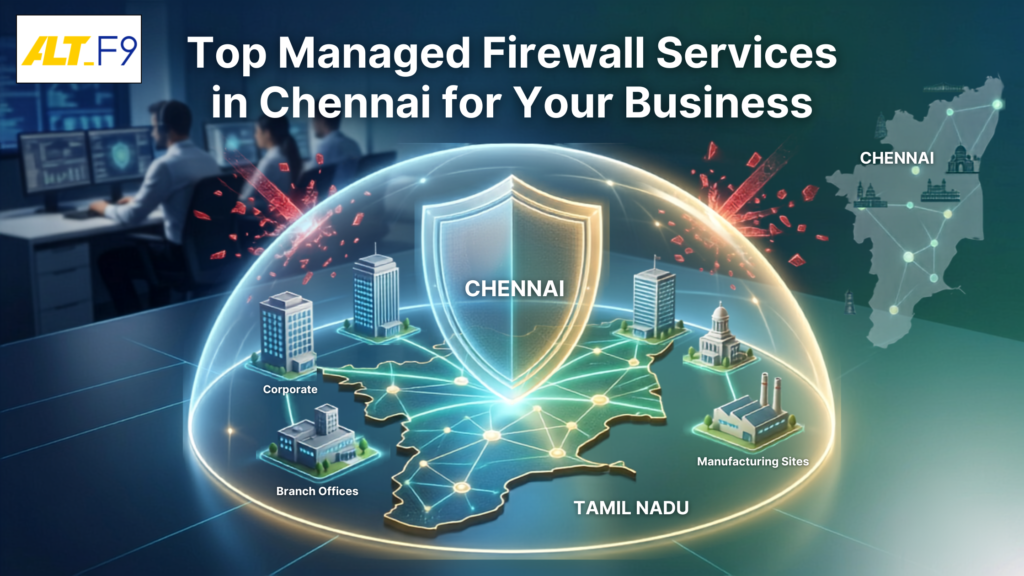
Top Managed Firewall Services in Chennai: Secure Your Multi-Site Business Network
Expanding your commercial footprint across multiple operating nodes is a major milestone for a growing enterprise. However, expanding from a headquarters in Chennai to manufacturing facilities in Sriperumbudur, tech centers in OMR, or satellite offices across Tamil Nadu fundamentally transforms your risk exposure. Your security framework can no longer rely on protecting a single local network—it must safeguard distributed branches, hybrid cloud environments, and remote engineering teams against zero-day threats.
Relying on off-the-shelf, unmanaged routers or fragmented software rules leaves critical operational backdoors open. Forward-thinking business leaders and technology executives are replacing reactive IT fixes with enterprise-grade managed firewall services in Chennai. Offloading boundary protection to specialized cybersecurity partners converts emergency incident response into a proactive, automated defense perimeter designed to scale seamlessly.
Table of Contents
- The Multi-Site Attack Surface: Why Basic Boundaries Fail
- The 5-Phase Blueprint for Multi-Site Network Hardening
- Perimeter Security Architecture Matrix
- Compliance First: Aligning Firewalls with DPDP Act and CERT-In Rules
- Coordinating Firewall Defense with Cloud Migration Playbooks
- Key Emerging Trends in Network Security Architecture
- Best Practices, Common Mistakes, and Real-World Examples
- Summary
- Frequently Asked Questions
- Conclusion
The Multi-Site Attack Surface: Why Basic Boundaries Fail
A distributed network’s security is defined by its weakest branch location. An unmonitored router at a regional warehouse or an unpatched connection used by a remote employee provides attackers with an instant gateway into core corporate databases.
The Hidden Costs of Self-Managed Firewall Hardware
In-house IT teams often struggle with high ticket volumes and basic desktop support. Hardware configurations and manual application fixes drain their bandwidth, pushing complex perimeter management to the background.
This leads to several critical vulnerabilities:
- Security policies remain at risky factory default settings.
- Firmware updates lag months behind official security releases.
- Event logs sit isolated on physical local drives, unreviewed.
- Zero visibility during non-business hours allows automated ransomware scripts to exploit open ports across branch sites.
The Strategic Advantage of Managed Gateway Resilience
Transitioning to managed IT services replaces fragmented perimeter controls with a single-pane security architecture. Fully managed firewall solutions deploy unified Next-Generation Firewall (NGFW) and Unified Threat Management (UTM) policies consistently across every branch node.
Centralized Security Operations Center (SOC) monitoring uses deep packet inspection and automated threat isolation to catch anomalous traffic, zero-day exploits, and rogue payloads before they breach core internal networks.
The 5-Phase Blueprint for Multi-Site Network Hardening
Reconfiguring multi-branch network perimeters requires a structured deployment methodology. Modifying access rules without environment validation can cause database drops and operational downtime.
- Traffic Auditing & Dependency Discovery (Phase 1: 1–2 Weeks)Deploy lightweight telemetry tools across office branches and cloud environments. Map active data streams, pin down core application dependencies, and create a blueprint of all perimeter entry points.
- Rule Base Simplification & Policy Design (Phase 2: 1 Week)Audit and eliminate conflicting legacy firewall rules. Build a zero-trust, identity-centric access control framework built on the principle of least privilege.
- Deep Packet Inspection & Sandbox Activation (Phase 3: 2–3 Days)Enable NGFW telemetry across every edge gateway. Implement automated SSL/TLS decryption loops and cloud-based sandboxing to analyze untrusted attachments before they reach user endpoints.
- Live Cutover & Verification Testing (Phase 4: Weekend Window)Execute network migration during off-peak hours to avoid business disruption. Run automated stress runbooks to verify link failovers, VPN throughput, and routing resilience under load.
- Proactive NOC Telemetry & Patching (Phase 5: Continuous Upkeep)Connect your edge security layer to a centralized Network Operations Center (NOC) using multi-tiered escalation protocols (L1/L2/L3). Maintain real-time updates for threat definitions, firmware builds, and security policies.
Perimeter Security Architecture Matrix
Selecting the right security management framework requires evaluating capabilities across critical operational parameters:
| Operational Parameter | Legacy Out-of-the-Box Router | Unmanaged Next-Gen Hardware | AltF9 Managed Firewall Service |
| Traffic Inspection Depth | Shallow; checks basic ports/IPs; misses hidden malware. | Moderate; supports deep inspection but often disabled due to latency. | High-Performance; automated SSL decryption & cloud sandboxing active tenant-wide. |
| Multi-Site Connectivity | Fragmented; relies on manual point-to-point site tunnels. | Variable; requires internal staff to manually configure branch links. | Hyper-Resilient; automated SD-WAN architectures with immediate link failover. |
| Threat Containment Speed | None; threats must be identified after damage occurs. | Reactive; flags alerts that internal staff only view during office hours. | Real-Time; automated security rules isolate rogue payloads at the edge instantly. |
| Budget Predictability | Volatile; high emergency maintenance fees and licensing surprises. | Unpredictable; high upfront hardware costs and recurring renewal fees. | Predictable; flat-rate per-user or fixed infrastructure pricing models. |
| Compliance Readiness | Non-Compliant; local history logs routinely purge early to free space. | High Risk; logs remain fragmented on disconnected local drives. | Audit-Ready; automated log streaming directly to tamper-proof 180-day storage. |
Compliance First: Aligning Firewalls with DPDP Act and CERT-In Rules
Operating corporate IT infrastructure in India requires strict adherence to digital governance frameworks. A misconfigured network perimeter exposes organizations to severe legal liability and operational disruption.
                       +-------------------------------+
                       |  Indian Regulatory Compliance |
                       +---------------+---------------+
                                       |
                   +-------------------+-------------------+
                   |                                       |
                   v                                       v
+------------------------------------+   +------------------------------------+
|         DPDP Act Alignment         |   |    CERT-In Log Retention Compliance|
|  - Role-based access controls      |   |  - Mandatory 180-day log history   |
|  - Data encryption across edge     |   |  - Real-time tamper-proof logging  |
|  - Protection against ₹250Cr fines |   |  - 6-hour incident reporting readiness|
+------------------------------------+   +------------------------------------+
Aligning with the Digital Personal Data Protection (DPDP) Act
The Digital Personal Data Protection (DPDP) Act mandates that organizations operating as Data Fiduciaries maintain stringent cybersecurity controls. Failing to implement reasonable security safeguards to prevent personal data breaches can incur statutory penalties up to ₹250 crore per incident.
Organizations must report personal data breaches to the Data Protection Board of India (DPBI) without delay. Configuring strict edge access rules, role-based controls, and automated encrypted tunnels forms your primary defense against regulatory exposure.
Navigating CERT-In 180-Day Log Retention Directives
Directives from the Computer Emergency Response Team (CERT-In) require commercial entities to store complete network transaction logs—including firewall event streams, connection histories, and user access trails—for a rolling minimum of 180 days within Indian jurisdiction.
Furthermore, confirmed cybersecurity incidents must be reported to the national CERT-In portal within six hours of detection. Standard firewall appliances often purge logs early to save local memory. AltF9 Technology Solutions solves this compliance gap by streaming telemetry directly to secure, Write-Once-Read-Many (WORM) storage repositories.
Coordinating Firewall Defense with Cloud Migration Playbooks
Edge firewall hardening should not take place in isolation. To achieve true operational resilience, your perimeter security strategy must integrate directly with your enterprise cloud ecosystem.
When executing a cloud migration strategy, organizations transition business-critical applications and databases from aging on-premise servers to public cloud environments like AWS or Microsoft Azure. Modernizing edge firewalls ensures these hybrid data pathways remain secure, preventing bandwidth bottlenecks and unencrypted data leaks while maintaining reliable throughput for cloud applications.
Key Emerging Trends in Network Security Architecture
Maintaining an active security strategy requires adopting key shifts in enterprise infrastructure management:
- AI-Driven Threat Detection: Security systems now leverage machine learning models to analyze behavioral network telemetry in real time, isolating anomalous file behavior before signature updates are published.
- Identity-First Zero Trust Access: Traditional trust perimeters are being replaced by dynamic Zero Trust models. Every connection request—whether from inside or outside the office—is continuously authenticated based on device compliance, user identity, and location context.
- Hyper-Converged SASE Frameworks: The integration of Secure Access Service Edge (SASE) combines physical edge appliances with cloud-native security services, delivering scalable policy enforcement for remote workforces.
Best Practices, Common Mistakes, and Real-World Examples
Best Practices for Edge Security
- Enforce Multi-Factor Authentication (MFA) across all administrative firewall portals and client VPN entry points.
- Segment local networks using Virtual LANs (VLANs) to separate corporate data, IoT hardware, and guest Wi-Fi traffic.
- Establish automated weekly configuration backups to accelerate disaster recovery timelines.
Common Firewall Management Mistakes
- Leaving default vendor passwords active on production hardware gateways.
- Permitting broad, unmonitored “Any-to-Any” outbound traffic rules that allow command-and-control malware beaconing.
- Disabling Deep Packet Inspection (DPI) to avoid processing overhead instead of sizing hardware correctly.
Real-World Example: Scaling Secure Connectivity Across Tamil Nadu
A mid-sized automotive components manufacturer based in Chennai expanded operations to include three production units in Coimbatore and Hosur. Initially relying on basic site routers and unencrypted connections, the company experienced frequent line drops and bandwidth throttling during ERP synchronization.
By partnering with AltF9 to deploy managed firewall appliances backed by SD-WAN architectures, the enterprise achieved:
- 99.99% uptime across all production facilities through automated link failover.
- Full compliance with CERT-In log retention mandates using centralized cloud logging.
- 60% reduction in internal IT support tickets tied to VPN connectivity issues.
Summary
Managing enterprise growth requires securing your network perimeter against increasingly complex threat vectors. Unmanaged routers and overloaded IT teams create compliance gaps and security risks across multi-site operations.
Implementing a managed firewall service gives your business dedicated security expertise, automated threat mitigation, predictable operating expenses, and full compliance with Indian regulatory mandates like the DPDP Act and CERT-In rules.
Frequently Asked Questions
What is a managed firewall service?
A managed firewall service offloads the administration, monitoring, rule configuration, patch management, and threat response of your network security gateways to an external team of specialized cybersecurity engineers.
How do managed firewalls support DPDP Act compliance?
Managed firewalls enforce encryption standards, restrict unauthorized access through role-based access policies, and prevent unauthorized data exfiltration, helping satisfy the DPDP Act’s “reasonable security safeguards” requirement.
What is the CERT-In rule for log retention in India?
CERT-In mandates that all corporate entities retain user access records, network connection logs, and firewall event histories for at least 180 days within India.
Can managed firewalls integrate with cloud platforms like AWS and Azure?
Yes. Modern Next-Generation Firewalls support hybrid cloud deployments, providing secure, encrypted tunnels and unified access policies across physical offices and cloud environments like AWS and Azure.
How quickly does AltF9 respond to potential firewall security threats?
AltF9’s centralized Security Operations Center (SOC) utilizes automated AI threat monitoring to detect and isolate anomalous traffic within seconds, backed by strict escalation SLAs.
Conclusion
Relying on legacy branch configurations, unpatched hardware, or overburdened internal staff creates unnecessary operational vulnerability. Upgrading your perimeter defense with managed firewall services gives your organization the network stability, data protection, and predictable operational costs needed to scale safely.
AltF9 Technology Solutions handles end-to-end network security management—from rule architecture and compliance logging to continuous monitoring and cloud integration—allowing your team to focus on driving core business growth across Chennai, Tamil Nadu, and beyond.
Ready to Modernize Your IT?
Whether you’re planning a cloud migration, improving cybersecurity, optimizing Microsoft 365, or upgrading your IT infrastructure, AltF9 Technology Solutions Pvt. Ltd. is here to help.
Contact our experts today
📞 Phone: +91 8056005901
📧 Email: Contact@altf9.tech
🌐 Website: https://altf9.tech
Let’s build a secure, scalable, and future-ready IT environment for your business.