

Choosing between Azure and AWS can be daunting for Indian businesses. Discover the strengths of each cloud solution to make an informed decision.
Overview of Azure and AWS
In today’s fast-paced digital landscape, cloud computing has become a cornerstone of business innovation and efficiency. Two of the most prominent players in this domain are Microsoft Azure and Amazon Web Services (AWS). Both platforms offer a staggering array of services and features designed to cater to the diverse needs of businesses. However, the challenge lies in choosing the right cloud solution that aligns with specific business requirements, especially for Indian enterprises navigating unique market dynamics.
Azure, launched by Microsoft in 2010, has rapidly evolved into a comprehensive cloud platform offering over 200 products and cloud services. It aims to help businesses solve today’s challenges and create the future. Azure’s services range from computing, analytics, storage, and networking, to more advanced services like artificial intelligence, Internet of Things (IoT), and machine learning. Its seamless integration with Microsoft’s software ecosystem, including Office 365 and Dynamics 365, makes it a compelling choice for businesses already invested in Microsoft products.
On the other hand, AWS has been a pioneer in the cloud computing space since its inception in 2006. As the oldest and most mature cloud service provider, AWS offers a vast and evolving array of services, including computing power, storage options, and networking capabilities. AWS’s extensive global infrastructure and broad service portfolio make it a versatile platform suitable for startups, enterprises, and public sector organizations. Its pay-as-you-go pricing model and robust security features have earned it a significant market share and a loyal customer base worldwide.
Understanding the core features, cost implications, performance metrics, and security considerations of Azure and AWS is crucial for Indian businesses. Making an informed decision can significantly impact operational efficiency, scalability, and overall business growth. This article delves into the key aspects of both platforms, providing a comprehensive comparison to help Indian businesses choose the cloud solution that best meets their needs.
Key Features of Azure
Microsoft Azure stands out for its extensive integration capabilities and enterprise-focused features. One of the most significant advantages of Azure is its seamless integration with Microsoft products and services. Businesses that rely on Microsoft Office 365, Dynamics 365, or Windows Server can leverage Azure’s native integration to streamline operations and enhance productivity. Azure Active Directory, for example, provides robust identity and access management, allowing businesses to manage user permissions and resources efficiently.
Another notable feature of Azure is its hybrid cloud capabilities. Azure enables businesses to build and manage applications across on-premises, multi-cloud, and edge environments with Azure Arc. This flexibility is particularly beneficial for Indian businesses that may have legacy systems or specific regulatory requirements necessitating a hybrid approach. Azure Stack further extends Azure’s capabilities to on-premises environments, offering a consistent cloud experience across different deployment scenarios.
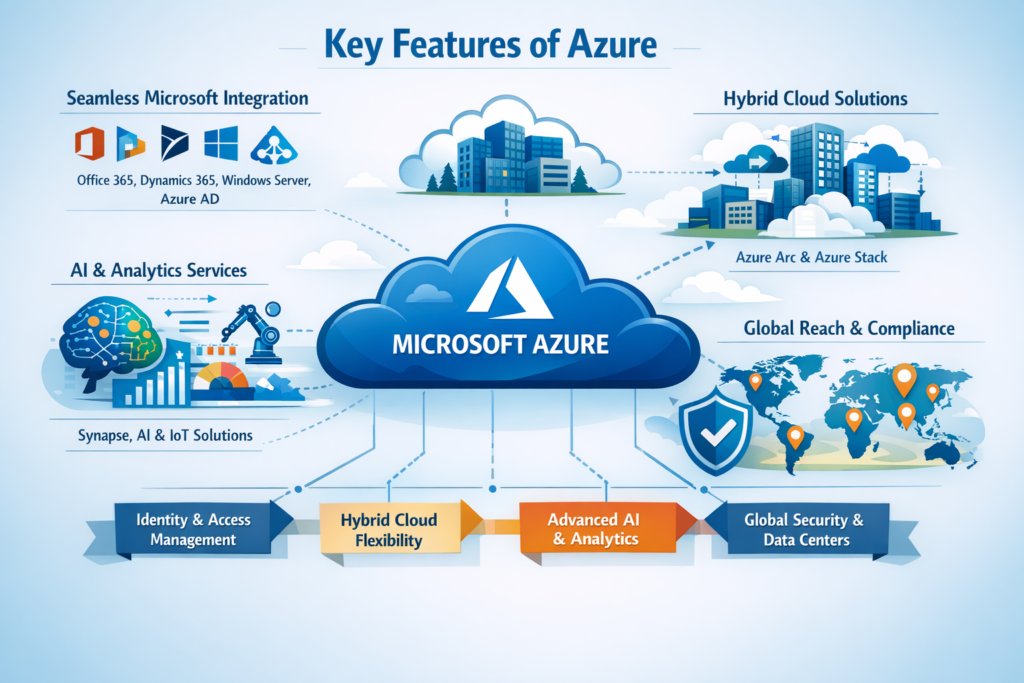
Azure’s advanced analytics and artificial intelligence services are also worth highlighting. Azure Synapse Analytics, Azure Machine Learning, and Cognitive Services empower businesses to derive actionable insights from their data and implement intelligent solutions. These services are designed to handle large-scale data processing and complex machine learning models, making them ideal for industries such as finance, healthcare, and retail. Additionally, Azure’s IoT offerings, including Azure IoT Hub and Azure Digital Twins, enable businesses to connect, monitor, and manage IoT assets effectively.
The global reach of Azure is another critical factor for Indian businesses. With data centers in over 60 regions worldwide, Azure ensures low-latency access and compliance with regional data residency requirements. This extensive network allows businesses to deploy applications closer to their customers and adhere to local regulations, which is particularly important for industries like finance and healthcare. Azure’s comprehensive security and compliance portfolio further enhances its appeal, providing businesses with the assurance that their data and applications are protected.
Key Features of AWS
Amazon Web Services (AWS) has established itself as a leader in the cloud computing industry, thanks to its extensive range of offerings and unmatched global infrastructure. One of the standout features of AWS is its breadth and depth of services. AWS offers over 200 fully-featured services across categories such as compute, storage, databases, networking, analytics, machine learning, and more. This extensive portfolio allows businesses to find tailored solutions for virtually any use case, from simple web hosting to complex machine learning applications.
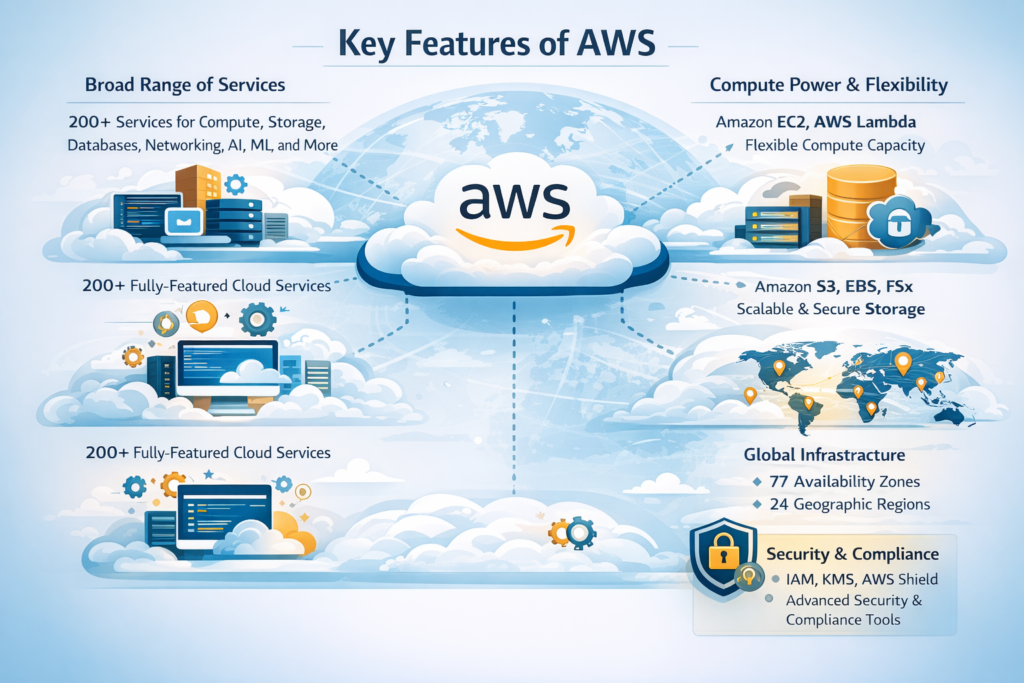
AWS’s compute services, notably Amazon EC2 (Elastic Compute Cloud), provide resizable compute capacity in the cloud. EC2 instances come in various types and sizes, allowing businesses to choose the right configuration based on their specific needs. AWS Lambda, another innovative compute service, enables businesses to run code without provisioning or managing servers. This serverless computing model is ideal for applications that require high scalability and flexibility, such as microservices and event-driven architectures.
Another key feature of AWS is its robust storage solutions. Amazon S3 (Simple Storage Service) offers scalable object storage with industry-leading durability, availability, and security. Businesses can store and retrieve any amount of data at any time, making S3 an ideal choice for data-intensive applications such as backup and restore, big data analytics, and content distribution. AWS also provides specialized storage services like Amazon EBS (Elastic Block Store) and Amazon FSx for file storage, catering to diverse storage requirements.
AWS’s global infrastructure is a significant advantage for businesses seeking reliable and low-latency access to cloud resources. With 77 Availability Zones across 24 geographic regions, AWS ensures high availability and fault tolerance for applications. This extensive network allows businesses to deploy applications closer to their end-users, reducing latency and improving performance. Additionally, AWS’s global presence supports compliance with regional data residency regulations, which is crucial for businesses operating in multiple countries.
The security and compliance features of AWS are also noteworthy. AWS employs a shared responsibility model, where AWS is responsible for securing the cloud infrastructure, while customers are responsible for securing their applications and data. AWS provides a comprehensive set of security tools and features, including AWS Identity and Access Management (IAM), AWS Key Management Service (KMS), and AWS Shield for DDoS protection. These tools help businesses safeguard their data and applications, ensuring compliance with industry standards and regulations.
Cost Comparison: Azure vs AWS
Cost is a critical factor for businesses when choosing a cloud service provider, and both Azure and AWS offer competitive pricing models. However, the cost structure can vary significantly based on the specific services used, the scale of operations, and the region of deployment. Understanding the cost implications of each platform is essential for businesses to optimize their cloud spending and achieve cost-efficiency.
Azure and AWS both offer pay-as-you-go pricing models, allowing businesses to pay only for the resources they use. This model provides flexibility and scalability, enabling businesses to adjust their resource usage based on demand. For instance, Azure’s compute services, such as Azure Virtual Machines, are billed based on the number of virtual machine instances and the duration of usage. Similarly, AWS’s EC2 instances are billed based on the instance type, region, and usage duration. Both platforms also offer reserved instances and savings plans, providing significant discounts for long-term commitments.
In terms of storage costs, Azure and AWS offer competitive pricing with slight variations. Azure’s primary storage service, Azure Blob Storage, charges based on the amount of data stored, data transfer, and operations performed. AWS S3 also follows a similar pricing model, with charges for data storage, data transfer, and API requests. Both platforms offer tiered storage options, allowing businesses to choose the most cost-effective storage solution based on their access frequency and data retention requirements.
Networking costs can also impact the overall cloud expenditure. Azure and AWS charge for data transfer between regions, known as data egress. However, both platforms offer free data transfer within the same region, which can help businesses minimize costs. Additionally, services like Azure ExpressRoute and AWS Direct Connect provide dedicated network connections between on-premises environments and the cloud, offering predictable performance and lower data transfer costs for high-volume workloads.
While the pricing models of Azure and AWS are similar, businesses should consider other factors such as the specific services used, the scale of operations, and the potential for hidden costs. For example, data transfer costs can add up quickly for applications with high outbound traffic. Therefore, it is essential to conduct a thorough cost analysis and leverage the pricing calculators and cost management tools provided by both platforms. Azure’s Cost Management and AWS’s Cost Explorer are valuable resources for monitoring and optimizing cloud spending.
Performance and Scalability
Performance and scalability are critical considerations for businesses seeking to leverage the cloud for their operations. Both Azure and AWS offer robust performance and scalability features, but there are differences in their approaches and capabilities. Understanding these differences can help businesses choose the platform that best aligns with their performance requirements and growth ambitions.
Azure’s performance is bolstered by its global network of data centers and extensive peering arrangements. With data centers in over 60 regions, Azure ensures low-latency access and high availability for applications. Azure’s Virtual Machines offer a wide range of compute options, including general-purpose, compute-optimized, memory-optimized, and GPU instances. This variety allows businesses to choose the right configuration for their workloads, ensuring optimal performance. Additionally, Azure’s Load Balancer and Traffic Manager services enable efficient traffic distribution and failover, further enhancing application performance.
Azure’s performance is bolstered by its global network of data centers and extensive peering arrangements. With data centers in over 60 regions, Azure ensures low-latency access and high availability for applications. Azure’s Virtual Machines offer a wide range of compute options, including general-purpose, compute-optimized, memory-optimized, and GPU instances. This variety allows businesses to choose the right configuration for their workloads, ensuring optimal performance. Additionally, Azure’s Load Balancer and Traffic Manager services enable efficient traffic distribution and failover, further enhancing application performance.
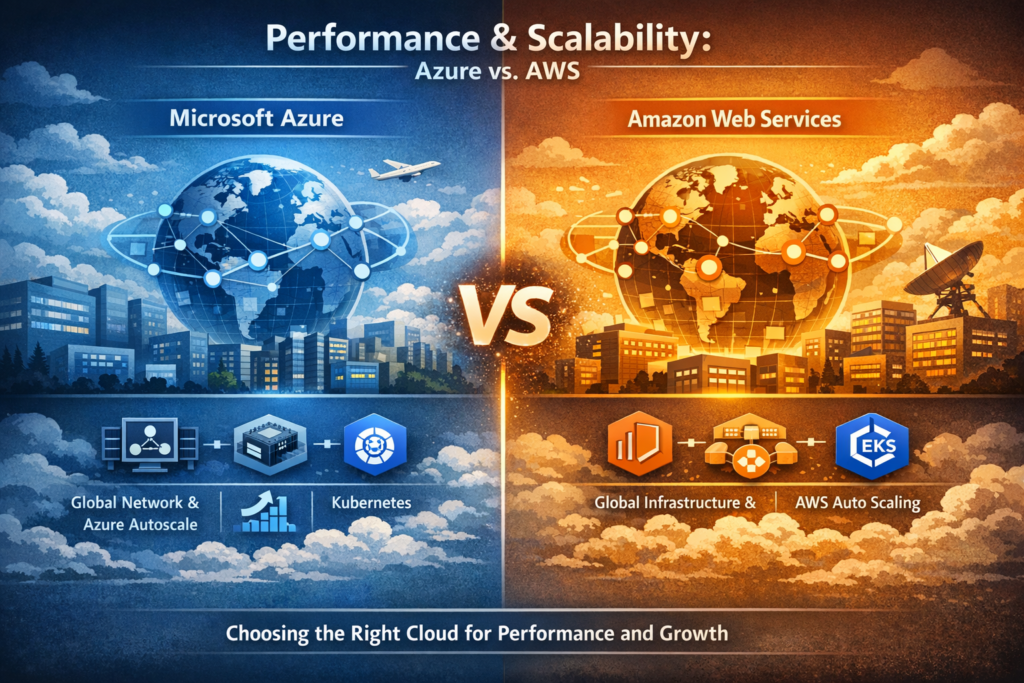
Scalability is a core strength of Azure, with features like Azure Autoscale and Azure Kubernetes Service (AKS) simplifying the process of scaling applications. Azure Autoscale automatically adjusts the number of virtual machine instances based on demand, ensuring that applications can handle varying workloads without manual intervention. AKS, a managed Kubernetes service, allows businesses to deploy, manage, and scale containerized applications with ease. This orchestration service supports automatic scaling, self-healing, and rolling updates, making it ideal for modern applications that require rapid scaling.
AWS also excels in performance and scalability, with a global infrastructure that spans 77 Availability Zones across 24 regions. AWS offers a wide range of compute instances through Amazon EC2, including general-purpose, compute-optimized, memory-optimized, and GPU instances. AWS’s Elastic Load Balancing (ELB) and Amazon CloudFront services further enhance performance by distributing traffic efficiently and delivering content with low latency. AWS Global Accelerator, a network optimization service, improves the performance of global applications by routing traffic through the AWS global network.
Scalability is a hallmark of AWS, with features like Auto Scaling and Amazon Elastic Kubernetes Service (EKS) providing automated scaling solutions. AWS Auto Scaling enables businesses to maintain optimal application performance by automatically adjusting the number of EC2 instances based on demand. EKS, a fully managed Kubernetes service, simplifies the deployment, management, and scaling of containerized applications. EKS integrates seamlessly with other AWS services, providing a scalable and resilient environment for modern applications.
Both Azure and AWS offer robust performance and scalability features, but the choice between the two may depend on specific requirements and existing infrastructure. Azure’s seamless integration with Microsoft products and hybrid cloud capabilities make it an attractive option for businesses with a Microsoft-centric environment. On the other hand, AWS’s extensive service portfolio and mature infrastructure make it a versatile platform for a wide range of use cases. Businesses should evaluate their performance and scalability needs, considering factors such as latency, traffic patterns, and workload characteristics, to choose the platform that best meets their requirements.
Security and Compliance Considerations
Security and compliance are paramount concerns for businesses migrating to the cloud. Both Azure and AWS prioritize security and offer comprehensive security features to protect data and applications. However, there are differences in their approaches and specific offerings that businesses should consider when choosing a cloud provider.
Azure’s security framework is built on a multi-layered approach, encompassing physical, network, and application security. Azure Security Center provides a unified view of security across all Azure resources, offering advanced threat protection and security recommendations. Azure’s identity and access management capabilities, including Azure Active Directory, enable businesses to manage user identities, enforce multi-factor authentication, and implement conditional access policies. Azure’s encryption services, such as Azure Key Vault, allow businesses to safeguard cryptographic keys and secrets, ensuring data protection.
Compliance is a critical aspect of Azure’s security offerings, with Azure providing a comprehensive portfolio of compliance certifications and attestations. Azure complies with a wide range of international, industry-specific, and regional standards, including ISO 27001, GDPR, HIPAA, and SOC 1, 2, and 3. Azure’s compliance documentation and resources help businesses understand and meet regulatory requirements, making it easier to achieve and maintain compliance in the cloud. Additionally, Azure’s data residency options ensure that businesses can store and process data within specific geographic regions, addressing data sovereignty concerns.
AWS also employs a robust security framework, with security features integrated into every layer of its infrastructure. AWS Identity and Access Management (IAM) allows businesses to control access to AWSresources, enabling fine-grained permissions and multi-factor authentication. AWS Key Management Service (KMS) and AWS CloudHSM provide secure key management and encryption capabilities, ensuring data protection. AWS Shield and AWS WAF (Web Application Firewall) offer advanced DDoS protection and application security, safeguarding applications from cyber threats.
Compliance is a cornerstone of AWS’s security strategy, with AWS offering a broad range of compliance certifications and attestations. AWS complies with numerous global standards, including ISO 27001, GDPR, HIPAA, and PCI DSS. AWS’s Artifact service provides on-demand access to compliance reports, helping businesses demonstrate compliance to auditors and regulators. AWS’s global infrastructure and data residency options support compliance with regional data protection laws, ensuring that businesses can meet local regulatory requirements.
Both Azure and AWS offer comprehensive security and compliance features, but businesses should consider their specific needs and regulatory environment when choosing a cloud provider. Azure’s integration with Microsoft security tools and its focus on hybrid cloud security make it an attractive option for businesses with a Microsoft-centric environment. AWS’s extensive security tools and global compliance coverage provide a versatile and secure platform for a wide range of use cases. By evaluating their security and compliance requirements, businesses can choose the cloud provider that best meets their needs and ensures the protection of their data and applications.
Use Cases for Indian Businesses
Indian businesses operate in a diverse and dynamic market, with unique challenges and opportunities. BothAzure and AWS offer solutions tailored to the specific needs of Indian enterprises, enabling them to leverage the cloud for growth and innovation. Understanding the key use cases for each platform can help businesses choose the cloud provider that best aligns with their objectives and industry requirements.

For businesses in the financial services sector, Azure’s robust security and compliance features make it an attractive option. Azure’s multi-layered security framework and compliance certifications, including ISO 27001 and GDPR, ensure that financial data is protected and regulatory requirements are met. Azure’s advanced analytics and AI services, such as Azure Synapse Analytics and Azure Machine Learning, enable financial institutions to derive insights from their data, detect fraud, and personalize customer experiences. Additionally, Azure’s hybrid cloud capabilities allow financial institutions to integrate on-premises systems with the cloud, ensuring seamless and secure operations.
The healthcare industry in India can benefit from Azure’s comprehensive healthcare solutions. Azure’s compliance with healthcare standards such as HIPAA and its advanced security features ensure the protection of sensitive patient data. Azure’s AI and machine learning services, including Azure Health Bot and Azure Cognitive Services, enable healthcare providers to implement intelligent solutions for patient care, diagnostics, and personalized treatment plans. Azure’s IoT offerings, such as Azure IoT Hub and Azure Digital Twins, support remote patient monitoring and the management of medical devices, improving patient outcomes and operational efficiency.
For the retail sector, AWS offers a wide range of solutions to enhance customer experiences and optimize operations. AWS’s scalable infrastructure and global presence enable retail businesses to handle peak traffic during sales events and deliver low-latency experiences to customers. AWS’s analytics and machine learning services, such as Amazon Redshift and Amazon SageMaker, allow retailers to analyze customer data, predict trends, and implement personalized marketing strategies. AWS’s IoT services, including AWS IoT Core and AWS IoT Analytics, support inventory management, supply chain optimization, and the implementation of smart stores.
The manufacturing industry in India can leverage AWS’s robust IoT and analytics capabilities to drive digital transformation. AWS IoT Greengrass and AWS IoT SiteWise enable manufacturers to connect and monitor industrial assets, optimize production processes, and implement predictive maintenance. AWS’s machine learning services, such as Amazon Lookout for Equipment, provide insights into equipment performance and help prevent downtime. Additionally, AWS’s global infrastructure and edge computing solutions ensure low-latency access and real-time data processing, supporting the implementation of smart factories and Industry 4.0 initiatives.
Both Azure and AWS offer solutions tailored to the specific needs of Indian businesses, enabling them to innovate and achieve operational excellence. By understanding the key use cases and evaluating their industry requirements, businesses can choose the cloud provider that best aligns with their objectives and supports their growth.
Customer Support and Resources
Effective customer support and access to resources are crucial for businesses navigating the complexities of cloud adoption. Both Azure and AWS provide comprehensive support options and a wealth of resources to help businesses succeed in their cloud journey. Understanding the support offerings and available resources can help businesses choose the cloud provider that best meets their needs.
Azure offers a range of support plans tailored to different business requirements. The Basic support plan provides 24/7 access to billing and subscription support, as well as access to Azure’s extensive online documentation and community forums. The Developer support plan includes technical support during business hours, with response times based on the severity of the issue. The Standard and Professional Direct support plans offer 24/7 technical support, faster response times, and access to proactive guidance from Azure advisors. For businesses with mission-critical workloads, the Premier support plan provides personalized support, a designated account manager, and access to Azure engineering resources.
In addition to support plans, Azure provides a wealth of resources to help businesses get the most out of their cloud investment. Azure’s online documentation covers a wide range of topics, from getting started guides to advanced technical tutorials. Azure’s Learning platform offers free and paid training courses, including certifications that help businesses build cloud expertise. Azure’s online community, including forums and user groups, provides a platform for businesses to share knowledge and seek advice from other Azure users. Additionally, Azure’s customer success program offers personalized guidance and best practices to help businesses achieve their cloud objectives.
AWS also offers a variety of support plans to cater to different business needs. The Basic support plan includes 24/7 access to customer service, AWS documentation, and the AWS Support Center. The Developer support plan provides technical support during business hours, with response times based on the severity of the issue. The Business support plan offers 24/7 technical support, faster response times, and access to AWS Trusted Advisor for cost optimization and performance recommendations. For businesses with mission-critical workloads, the Enterprise support plan provides a designated Technical Account Manager (TAM), access to AWS infrastructure event management, and prioritized case handling.
AWS’s extensive resources help businesses succeed in their cloud journey. The AWS documentation provides comprehensive guides, tutorials, and reference materials for all AWS services. AWS Training and Certification offers a range of courses and certifications, from foundational to advanced levels, helping businesses build cloud skills and expertise. The AWS Knowledge Center and re:Post community platform provide answers to common questions and a forum for businesses to seek advice from AWS experts and other users. Additionally, AWS’s customer success program offers personalized support and best practices to help businesses achieve their cloud objectives.
Both Azure and AWS provide robust customer support and a wealth of resources to help businesses succeed in the cloud. By evaluating their support needs and leveraging the available resources, businesses can choose the cloud provider that best supports their cloud journey and ensures a smooth and successful adoption.
Conclusion: Choosing the Right Cloud Solution for Your Business
Choosing between Azure and AWS can be a daunting task, but the right decision ultimately depends on your business needs, existing IT infrastructure, budget, and long-term growth plans. Both Microsoft Azure and Amazon Web Services offer reliable, secure, and scalable cloud solutions that help businesses accelerate their digital transformation.
If your organization already works within the Microsoft ecosystem, Azure provides seamless integration, strong hybrid cloud capabilities, and enterprise-grade security. On the other hand, AWS is known for its wide range of services, global infrastructure, flexibility, and strong support for cloud-native and high-growth environments.
For Indian businesses, the best approach is to evaluate key factors such as performance, scalability, compliance requirements, cost optimization, and industry-specific needs. A proper cloud assessment can help you choose the platform that delivers maximum efficiency, security, and long-term value.
Selecting the right cloud platform not only improves operational agility but also reduces IT costs, enhances data protection, and prepares your business for future innovation and growth.
Need expert guidance to choose the right cloud solution?
📧 Email: contact@altf9.tech
📞 Phone: +91 8056005901
🌐 Website: https://altf9.tech
Get in touch with our cloud experts today to design a secure, scalable, and cost-effective cloud strategy for your business.