
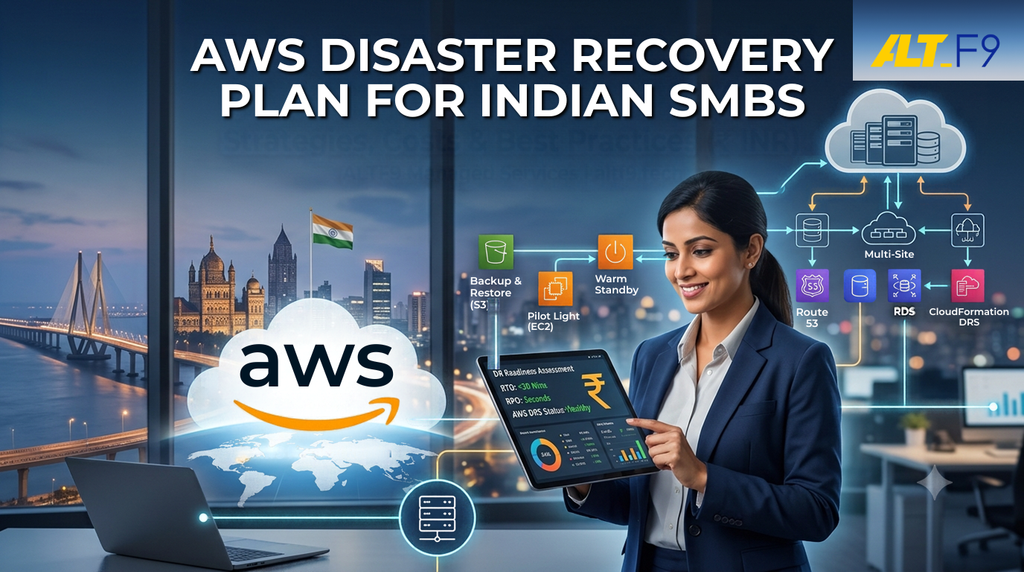
AWS Disaster Recovery Plan for Indian SMBs: Strategies & Costs
Unplanned downtime costs Indian SMBs more than most finance teams realize. Lost revenue is the obvious line item, but the less visible damage—broken client trust and potential compliance exposure under frameworks like the RBI IT Framework—compounds quickly once a system stays down for hours.
In assessing businesses across India, many SMBs either have no formal recovery plan at all, or they rely on a single daily backup stored in the same region as production that has never once been tested for a successful restore. That is not a disaster recovery plan; it is a hope.
AWS disaster recovery is not a single product you switch on. It is a structured spectrum of strategies, each with a defined cost, a defined recovery speed, and a set of AWS services that make it work. At AltF9, our Chennai-based managed cloud services team regularly runs DR readiness assessments for Indian businesses. The pattern we see most often is a severe mismatch between what a team believes their recovery capability to be and what it actually measures when tested.
This guide breaks down the four standard AWS disaster recovery strategies, the core services behind them, a practical testing checklist, and cost guidance in INR so you can make an informed decision for your workload.
The Four AWS Disaster Recovery Strategies and Costs (INR)
Every AWS disaster recovery architecture sits on a spectrum. The core principle is simple: cost and recovery speed are inversely related. You cannot have the fastest possible recovery at the lowest possible price. Your goal is to find the point where your recovery time objective (RTO) and recovery point objective (RPO) are met at a budget that makes sense for your application’s business value.
| DR Strategy | Recovery Speed (RTO) | Cost: Small Workload (Monthly)* | Cost: Medium Workload (Monthly)* | Best Use Case |
| Backup & Restore | Hours to 24+ Hours | ₹2,000 – ₹8,000 | ₹8,000 – ₹25,000 | Non-critical or dev/test workloads. |
| Pilot Light | Tens of minutes to Hours | ₹6,000 – ₹20,000 | ₹20,000 – ₹60,000 | The best value point for the majority of Indian SMBs. |
| Warm Standby | Minutes | ₹12,000 – ₹35,000 | ₹40,000 – ₹1,20,000 | Business-critical applications where downtime severely impacts revenue. |
| Multi-Site Active-Active | Near Zero | ₹25,000 – ₹70,000 | ₹90,000 – ₹2,50,000+ | Mission-critical systems requiring zero interruption. |
*Estimates based on AWS Mumbai-region pricing. Small = ~2 vCPU + small DB; Medium = 4–8 vCPU + moderate DB.
AWS Services That Enable Your Recovery Strategy
The strategy you choose determines which AWS services do the work. While EC2 and EBS are foundational, six specific services power most DR architectures.
AWS Elastic Disaster Recovery (DRS)
AWS DRS provides continuous replication without a standing DR fleet. It installs a lightweight replication agent on your source servers (on-premises or on EC2) and continuously syncs block-level changes to a low-cost staging area in your target AWS region.
You only launch full recovery instances during a drill or an actual failover event. This delivers an RPO measured in seconds and an RTO of 5 to 20 minutes without paying for a permanently running duplicate fleet.
- Pricing Model: $0.028 per source server per hour (approx. ₹1,680/server/month at ₹84/USD).
- Cost Example: For a business running 12 servers, the DRS replication cost alone is roughly ₹20,000 per month before storage and compute are added. There are no minimum commitments or per-drill charges.
The Infrastructure Layer: Route 53, CloudFormation, and RDS
- Amazon Route 53: Health-check-based failover routing automatically redirects DNS traffic to your recovery region when a primary health check fails, eliminating manual DNS updates during a crisis.
- AWS CloudFormation: Infrastructure-as-code templates ensure any environment can be rebuilt or scaled consistently without manual configuration.
- Amazon RDS: Automated snapshots provide point-in-time database recovery, while cross-region read replicas protect database state in the recovery region.
For hybrid infrastructures requiring multi-cloud or on-premises server backups, dedicated enterprise solutions like Acronis Backup Services or Veeam Replication Solutions can be integrated alongside AWS DRS.
Matching the Right Strategy to Your Workload
Choosing a strategy is a reasoning exercise. The two most critical inputs are application criticality (what does one hour of downtime cost the business?) and operational capacity (does your team have the engineering bandwidth to manage a manual failover?).
Ask these four questions to narrow your decision:
- What is the longest outage window the business can absorb before real damage occurs?
- How much data loss, measured in time (RPO), is acceptable?
- Does your team have the capacity to execute a manual failover runbook under pressure, or is heavy automation required?
- What is a reasonable DR budget as a percentage of your current production spend?
Answering these honestly will immediately rule out at least two of the four strategies. For a broader perspective on establishing business resilience, read our comprehensive Guide to Business Disaster Recovery Services in India.
Testing Your AWS Disaster Recovery Runbook: A Step-by-Step Checklist
A runbook that has never been tested is a hypothesis, not a plan. The most common failure pattern we see at AltF9 is a well-designed architecture that sits untouched, with no evidence that recovery instances actually launch or that the database restore reflects current data.
1. Before the Drill
- Verify the runbook reflects the current application stack.
- Document specific RTO and RPO targets.
- Assign explicit roles: Incident Lead, Application Owner, Infrastructure Owner, DNS Owner, and Business Validator.
- Confirm credentials and console access are reachable from outside the primary region.
- Check replication and backup health to ensure the latest recovery point is within the expected window.
- Prepare a rollback plan.
2. During the Drill
- Record the exact start time.
- Follow the runbook strictly. Do not improvise; deviations highlight where the runbook needs fixing.
- Validate the recovery point age against your RPO before promoting the environment.
- Test networking, IAM permissions, SSL certificates, and load balancer configurations.
- Validate core user journeys, read/write paths, integrations, and scheduled jobs.
3. After the Drill
- Measure the elapsed time until the application was fully usable and compare it to your RTO target.
- Update the runbook to remove ambiguous instructions or unnecessary manual steps.
- Create remediation tickets for any gaps in tooling, DNS, or monitoring.
- Schedule the next quarterly drill.
Keeping AWS Disaster Recovery Costs Manageable
Many Indian businesses overestimate DR costs and either over-provision or avoid planning entirely. Use these techniques to right-size your spend:
- Optimize Staging Environments: The AWS DRS staging area uses minimal compute and storage. There is no need to match production instance types in staging.
- Implement S3 Lifecycle Policies: For S3-backed backups, transition objects to S3 Glacier Instant Retrieval after 30 days and Glacier Deep Archive after 90 days. This materially reduces storage costs without impacting RTO.
- Audit Spend Quarterly: DR environments accumulate idle resources (outdated snapshots, unattached EBS volumes from old drills). A quarterly review using AWS Cost Explorer and Trusted Advisor keeps your DR budget aligned with actual needs.
To explore how cloud archiving fits into broader IT security guidelines, check out our Small Business Microsoft 365 Security Setup Guide.
How AltF9 Helps Indian SMBs Manage AWS DR
Building a DR architecture is one challenge; keeping it tested, documented, and aligned with a changing application stack over years is another. We partner with Indian businesses to handle both.
Our methodology includes:
- DR Readiness Assessments: Baselining your current RTO and RPO capabilities.
- Custom Architecture Design: Mapping AWS solutions to your application criticality and budget.
- Hands-On Implementation: Configuring AWS DRS, S3 replication, Route 53 failover, and CloudFormation stacks.
- Managed Operations & Compliance: Running quarterly drills, updating runbooks, and providing audit-ready evidence for frameworks like the RBI IT Framework and ISO 27001.
Learn more about how our Backup & Business Continuity Solutions in Chennai can protect your application workloads.
Real-World Impact: A Chennai-based professional services firm with 12 servers came to us relying on a single untested daily backup. We migrated them to a Pilot Light architecture using AWS DRS. Their measured RTO dropped to under 30 minutes, and their data loss window (RPO) narrowed from 24 hours to under five minutes—all for a modest monthly cost relative to their previous risk exposure.
AWS disaster recovery is highly accessible across a wide range of SMB budgets. The most expensive mistake is building a plan and never testing it.
To transition from an untested backup to a documented, compliance-ready architecture, book a DR assessment with our engineering team:
- Website: https://altf9.tech
- Email: contact@altf9.tech
- Phone: +91 8056005901